千山暮雪
Ju Xiaofu, a Chinese pianist who treats every note like a line of poetry_我的网站

一 |
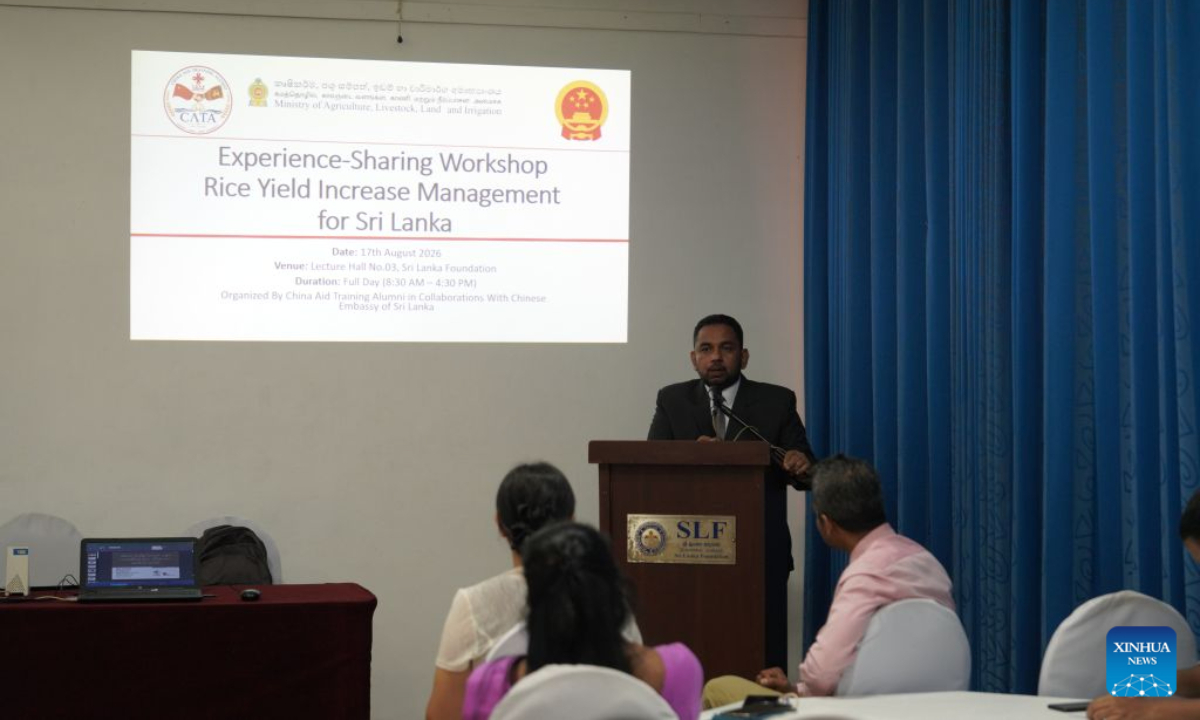
Organized by CATA Sri Lanka with support from the Chinese Embassy in Sri Lanka and Sri Lanka's Department of Agriculture, the workshop, themed "Rice Yield Increase Management for Sri Lanka," focused on high-yield rice varieties, seed technology, sustainable soil and water management, integrated pest and disease management, agricultural mechanization, post-harvest technologies, as well as policy and institutional support.
Sanjeewa Wimalagunarathna, president of CATA Sri Lanka, said in his welcome remarks that the event was the first experience-sharing workshop of its kind launched by the organization this year, describing the participating alumni as "pioneers" of the initiative.
He said the workshop would serve as a pilot for similar programs in the future and encouraged the alumni to provide frank and practical input based on both what they had learned during training in China and Sri Lanka's actual conditions, so that their experience and suggestions could be genuinely useful.
The representative of the Chinese Embassy in Sri Lanka said agriculture has long been an important area of practical cooperation between China and Sri Lanka.
She expressed hope that the alumni would make good use of the knowledge and experience they had gained in China and become a backbone force in Sri Lanka's agricultural development, while continuing to serve as ambassadors of friendship between the two countries, integrating their personal growth with national development and contributing to deeper bilateral cooperation.
During the workshop, Sri Lankan alumni shared techniques and practices they had learned in China in areas including high-yield varieties, water management, integrated pest management, mechanization and post-harvest technologies.
Participants were also divided into working groups to discuss seed technology and varietal improvement, sustainable soil and water management, integrated pest and disease management, mechanization and modern farming practices, post-harvest storage and marketing, as well as policy and institutional support.
Each group was tasked with developing a practical implementation roadmap containing specific recommendations, timelines, responsible institutions and required support. The roadmaps were then presented to relevant stakeholders for discussion and feedback, with a follow-up mechanism also envisaged by the organizers.
Rice is a staple food in Sri Lanka and plays an important role in the country's food security. Sri Lanka's annual paddy production reached about 5.05 million metric tons in 2025, up 7.6 percent from the previous year, according to the Central Bank of Sri Lanka.
China and Sri Lanka have continued to expand cooperation in human resources development and capacity building in recent years. China has organized aid-funded training programs for Sri Lankan participants from government departments, research institutions, business associations and enterprises.
According to the Chinese Embassy in Sri Lanka, nearly 14,000 Sri Lankan political and business representatives have participated in China-aid training programs in China over the years. In 2025 alone, approximately 1,000 Sri Lankan trainees participated in nearly 100 training programs, including 19 bilateral programs tailored to Sri Lanka's specific needs.
。

二 |

Deutsche Grammophon signed Ju earlier this year. The label has previously worked with well-known Chinese pianists including Li Yundi, Lang Lang and Yuja Wang. Ju's arrival raises a different question: What will younger musicians, trained both in China and the West, bring to classical music?
The album features works by Leoš Janácek, Maurice Ravel and Alexander Scriabin. The physical edition also includes three of Ju's own poems.
The title Mist Without draws on the German idea of Weltschmerz, a feeling of world-weariness, and the Chinese tradition of misty, suggestive poetry. Ju uses wu, the Chinese character for mist, to create a quieter and more reflective mood. The centerpiece of the album is Janácek's piano suite In the Mists.
"Poetry and piano are equal parts of my experiences," Ju said in a recent interview with the Global Times. "When I work on a single note or a phrase at the keyboard, it feels exactly like shaping a sentence - counting the syllables, weighing the rhythm, choosing the words."
For Ju, playing the piano is less a profession than a form of daily discipline. "It is stricter than many formal religions," he said.
Now in his mid-20s, Ju previously studied at the Juilliard School in New York before continuing his training in Germany. His approach, rooted in China yet open to the world, reflects a generation of Chinese musicians increasingly comfortable moving between cultures. For Ju, that movement between cultures is not necessarily something that needs to be explained.
"Culture can be learned," Ju said. He hears a deep kinship between turn-of-the-century France and ancient China: "To me, so much of [Claude] Debussy's late work feels like Tang Dynasty (618-907) poetry."
Western critics have already taken notice of Ju's distinctive style. In a 2024 review of his Carnegie Hall recital, New York Concert Review wrote that he "shines in the magic of the understated, pulling us into his psychological stillness." British critic Jed Distler, writing in Gramophone, praised his sensitive understanding of Janácek's music.
Having grown up navigating multiple languages and later pursuing training abroad, Ju sees cultural boundaries less as barriers than as things to move through.
"Unlike before, we can now present Eastern ideas not as a deliberate statement, but as something entirely natural and self-assured," he said.
Ju does not present Mist Without as a grand statement. "It is simply the first step in creating recordings that carry personal thought rather than polished display," he said.
Asked what AI might bring to classical music, Ju was unequivocal.
"If what you care about is the relationship between music and people, AI cannot provide that," he said. "AI represents the perfection of human intelligence. Art shows human nature - its desires, its light and its darkness. Music is about human imperfection."
。
Current article:http://zfx.bainangmieruopanglaomen.sbs/news/20260826_8283.html
Published on:00:00:00
 可凡倾听
可凡倾听 nba
nba 花千骨
花千骨 打架成本警示牌
 不结婚
不结婚 4公司声讨战狼2
 浪漫满屋
浪漫满屋 非诚勿扰
非诚勿扰


